
Tinnitus | Living Alongside It
Why Fighting Your Tinnitus
Makes It Worse
The brain amplifies what it monitors. Understanding this one principle changes everything about how tinnitus is managed and why most people are given the wrong advice.
There is a particular kind of cruelty in the instruction most people with tinnitus receive. They are told, in one breath, that nothing can be done and they should try not to think about it. As if those two things were compatible. As if the instruction “not to notice a sound you cannot turn off” was a treatment plan.
It is not. And the damage this advice does, the anxiety it creates, the vigilance it entrenches, the false belief that persistence means failure, is one of the most preventable sources of tinnitus distress in clinical practice.
This article is about a different way of understanding what tinnitus is, what the brain is doing when it generates it, and why the instinct to fight it is precisely the thing that keeps it central. It is also about what the evidence actually supports, including why ninety days of honest, structured reflection changes the neurology, not just the mood.
First, what tinnitus actually is
Tinnitus is not a disease. It is a symptom, the perception of sound that has no external source. Ringing, buzzing, hissing, roaring, clicking. Sometimes high-pitched, sometimes low. Sometimes one ear, sometimes both, sometimes a sound that seems to originate inside the head itself.
The sound is real. It is being generated, not imagined, not exaggerated, not a sign of mental illness. The source is the auditory system. In most cases, the inner ear has sustained some degree of damage, from noise exposure, from age, from other causes, and the hair cells of the cochlea are sending fewer signals to the brain than before.
The brain, deprived of its usual acoustic input, does not simply go quiet. It compensates by turning up its own gain, increasing its sensitivity to the signal it is receiving. In doing so, it begins to generate spontaneous activity in the auditory pathways. That activity is tinnitus.
Think of a phantom limb. Patients who have lost a limb often feel pain in the absent arm or leg, because the brain’s map of the body has not been updated to reflect the loss. Tinnitus follows the same principle: the sound is real, but the source is internal. [Schaette & McAlpine, Journal of Neuroscience, 2011]
This distinction matters enormously, because it changes the therapeutic target. You are not trying to fix an ear. You are trying to teach a brain.
The loop that keeps it loud
Here is the part that most patients are never told, and that changes everything once they understand it.
The brain has a threat-detection system, the limbic system and the autonomic nervous system, that decides, continuously, what deserves attention and what can safely be ignored. Most of what your brain processes never reaches conscious awareness: the sound of the air conditioning, the feeling of your clothes against your skin. These are present, but classified as non-threatening and filtered out.
When tinnitus first appears, it is new, unexplained, and alarming. The brain correctly classifies it as something that requires attention. You listen more carefully. You monitor it constantly, checking whether it has changed, hoping it has gone, dreading that it has grown.
The vigilance, the resistance, the continuous monitoring, this is not a response to the problem. This is the problem. The brain amplifies what it attends to. Every act of checking confirms to the threat-detection system that this sound is important.
Clinical mechanism underlying tinnitus distress

This is not a character flaw or weakness. It is the brain doing exactly what it was designed to do when presented with something new, persistent, and unexplained. The problem is that the instinct to attend, to monitor, to resist is precisely the mechanism that keeps the sound at the centre of conscious experience.
What habituation actually means
The word habituation is used frequently in tinnitus management and understood almost universally to mean the wrong thing. Patients who are told they will habituate often hear: you will stop hearing it. When the sound persists, as it usually does, they conclude they have failed at a process they were never given the tools to understand.
Habituation means something more precise, and more genuinely hopeful, than silence.

Habituation is the reclassification of the tinnitus signal by the brain’s threat-detection system from central to background. Not the absence of the sound. The gradual withdrawal of its power over your attention, your sleep, your relationships, and your sense of who you are.
This does not happen by willpower or by ignoring the sound. It happens through consistent, repeated experience of the sound being present and life continuing anyway. The brain learns, gradually, that the signal does not require a response. [NICE Guideline NG155, 2020]
The four things the evidence supports
There is no cure for tinnitus in most cases. That is an honest statement, because false promises of silence breed despair when the silence does not come. What the evidence does support, clearly, and with consistent clinical backing, is a set of approaches that reduce the brain’s threat response and accelerate habituation.
-
1Sound Enrichment
Keep a low level of background sound in your environment at all times, particularly at night and in quiet rooms. Nature sounds, brown or pink noise, a fan, quiet music with no gaps. The goal is not to mask the tinnitus but to give the brain other input to process. Recommended explicitly by NICE (NG155, 2020).
-
2Cognitive Behavioural Therapy
CBT for tinnitus is the highest-evidence psychological intervention available and is recommended by NICE as the primary treatment for tinnitus distress. It addresses the threat-classification process directly, changing the cognitive and emotional response to the sound, not the sound itself.
-
3Hearing Aids (where hearing loss is present)
If tinnitus is associated with hearing loss (which it is in approximately 90% of cases), hearing aids are frequently the single most effective intervention. They restore the acoustic input the brain was compensating for in the first place. Ask specifically for an audiogram if you have not had one.
-
4Structured Reflection and Tracking
Daily tracking of tinnitus volume, sleep quality, and stress reveals patterns invisible from within the experience. Reflective practice, morning and evening, consistently, builds the observational distance that is the precondition for habituation. You cannot reclassify what you are still inside of.
See Your Own Patterns
You cannot share your tinnitus with anyone. But you can see your patterns. The free Tinnitus Tracker logs daily volume, triggers, sleep impact, and mood — and shows you trends over time. Use it for 30 days, then bring your data to your ENT, therapist, or audiologist. Sometimes showing is more powerful than describing.
Why ninety days, and why morning and evening
Ninety days is not an arbitrary number. It is the approximate timescale over which consistent, repeated experience produces measurable changes in the brain’s threat-response architecture. The research on neuroplasticity and habituation does not support a two-week sprint. It supports sustained, incremental, structured practice.
Morning and evening matters for a specific reason. The morning rating captures the baseline signal before the day’s demands and stresses have interacted with it. The evening prompts engage a different cognitive mode. The morning asks: what are you noticing? The evening asks: what does it mean?
The people who find their way through tinnitus are not the ones who found a miracle. They are the ones who kept showing up to the tracking, the reflection, the small daily practice of not being defined by something they cannot yet control.
Over weeks, the data begins to tell a story: the tinnitus is louder after poor sleep, after stress, after noise exposure. And the act of recording morning and evening, day after day, begins to shift the observer relationship. You are no longer inside the experience. You are documenting it. That shift is small, and it is everything.
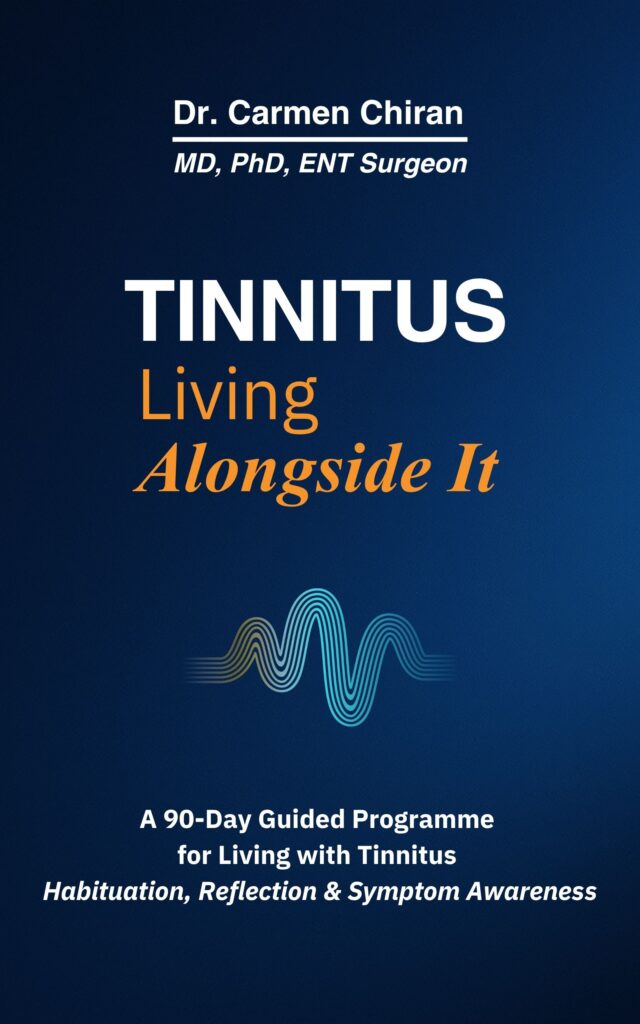
This journal brings together the tracking structure, the reflective prompts, and the clinical framework described in this article into a single 90-day practice. Written by Dr. Carmen Chiran and designed around the habituation research. Includes morning and evening prompts, weekly reviews, validated scaling guides, and a clinical summary page to bring to your GP or ENT appointment. Available on Amazon.
When tinnitus requires urgent medical attention
Most tinnitus is benign in its cause, associated with hearing loss, noise exposure, or age-related auditory change. But certain patterns require prompt medical review.

- Tinnitus with sudden hearing loss: ENT emergency. 72-hour treatment window. Contact your GP or attend A&E the same day.
- Tinnitus in one ear only: Requires MRI to exclude vestibular schwannoma, a benign, slow-growing tumour on the hearing nerve.
- Pulsatile tinnitus (rhythmic, beating, synchronised with your heartbeat): May have a vascular cause and requires imaging.
- Tinnitus with dizziness, vertigo, or facial symptoms: Requires prompt neurological assessment.
- Tinnitus with ear pain or discharge: Points to middle ear pathology, needs clinical examination.
- Tinnitus that started with a new medication: Discuss with your prescribing doctor before making any changes.
If none of these apply — if your tinnitus is in both ears, came on gradually, and has been present for months or years — the likelihood of a dangerous underlying cause is low. You still deserve proper assessment, including a hearing test.
Tinnitus: First Steps
A free 4-page patient guide covering what tinnitus is, the red flags that need prompt attention, and the five questions to bring to your GP or ENT appointment.
Frequently Asked Questions
For some people, particularly those with tinnitus caused by a specific, reversible trigger such as ear wax impaction or a medication, it does resolve completely when the cause is addressed. For most people with tinnitus associated with hearing loss, the sound persists, but its impact reduces substantially with appropriate management. Habituation is achievable for the majority. The goal is not silence; it is a life in which the sound is no longer the loudest thing in the room.
Stress does not cause tinnitus, but it reliably amplifies it. The autonomic nervous system heightens the brain’s sensitivity to perceived threats under stress. The tinnitus signal, already flagged by the threat-detection system, is amplified accordingly. Managing stress (sleep, exercise, connection, reduced vigilance around the sound) consistently reduces perceived tinnitus volume.
Tinnitus Retraining Therapy (TRT) combines directive counselling with sound therapy, aiming to promote habituation by reducing the emotional and attentional response to the signal. CBT for tinnitus works directly on the cognitive and emotional processes that maintain distress. The evidence base for CBT is stronger and more consistent, and it is the approach recommended by NICE (NG155, 2020).
At safe volumes, yes. The risk is using earphones at high volumes to mask the tinnitus, adding further noise exposure to an auditory system already compensating for damage. The 60/60 guideline: no more than 60% volume, for no more than 60 minutes continuously. If you use sound enrichment at night, use a speaker, not earphones.
Unilateral tinnitus requires medical assessment to exclude vestibular schwannoma, a benign, slow-growing tumour on the vestibulocochlear nerve. This is rare: the diagnostic yield from MRI in unilateral tinnitus is low, but the investigation is recommended because the consequences of missing it are significant. Most cases do not have a serious cause, but this is the pattern that warrants an MRI referral.
- Schaette R, McAlpine D. Tinnitus with a normal audiogram: physiological evidence for hidden hearing loss. Journal of Neuroscience. 2011;31(38):13452–13457.
- National Institute for Health and Care Excellence. Tinnitus: assessment and management. NICE Guideline NG155. London: NICE; 2020.
- British Tinnitus Association. Sound therapy and tinnitus management. tinnitus.org.uk.
- Cima RFF et al. A multidisciplinary European guideline for tinnitus. HNO. 2019;67(Suppl 1):10–42.
- McKenna L et al. A scientific cognitive-behavioral model of tinnitus. Front Neurol. 2014;5:196.
Medical disclaimer: This article is for educational purposes only and does not constitute medical advice. It is not a substitute for consultation with a qualified healthcare professional. If you are concerned about your tinnitus or any associated symptoms, please seek medical assessment. Nothing in this article should delay seeking appropriate clinical care.
📖
Tinnitus Living Alongside It | A 90-Day Guided Programme
This guided programme brings together the tracking structure, the reflective prompts, and the clinical framework described in this article into a single 90-day practice, designed around the habituation research. Includes morning and evening prompts, weekly reviews, validated scaling guides, and a clinical summary page to bring to your GP or ENT appointment. Available in Kindle on Amazon.