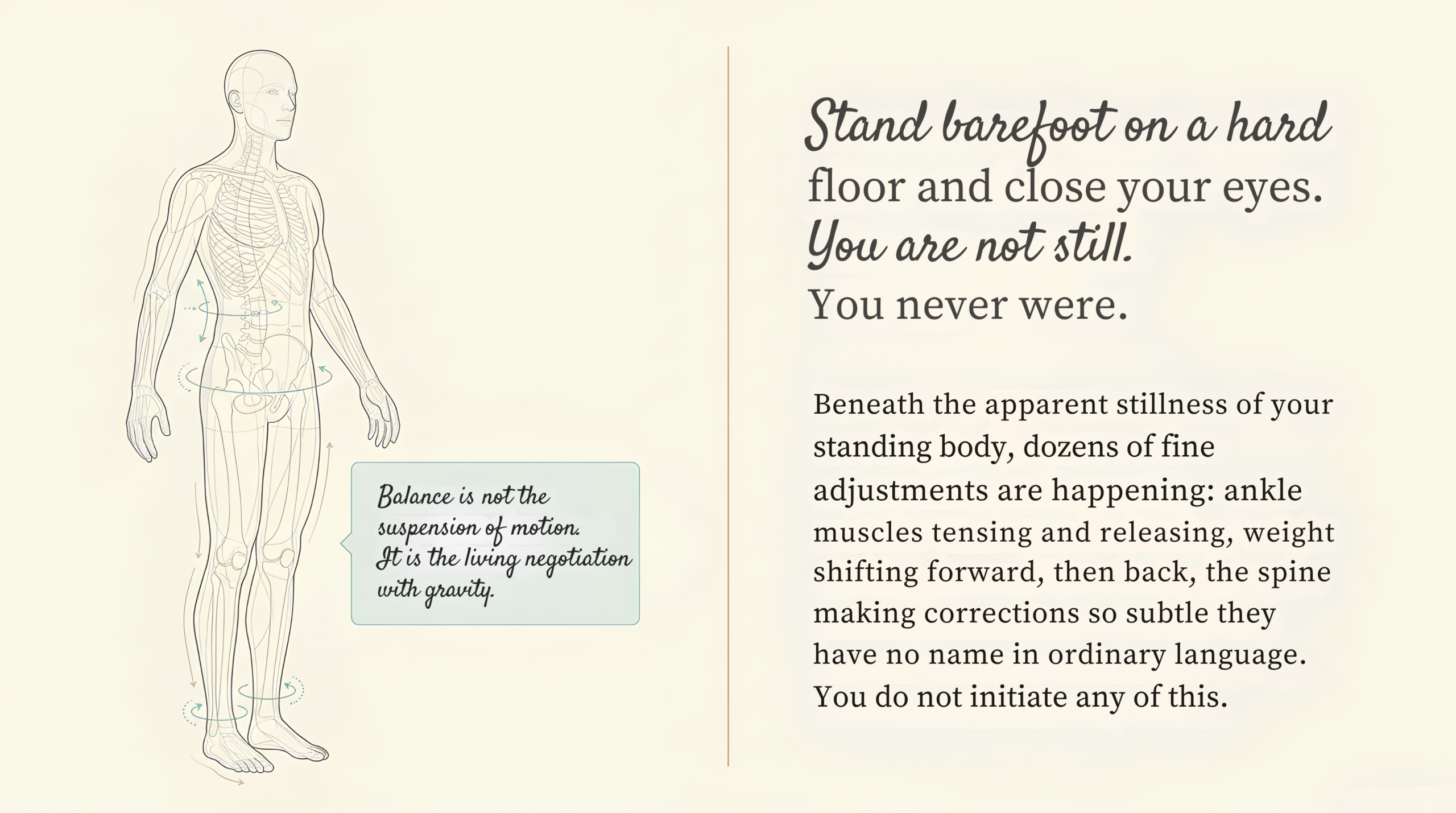
Stand barefoot on a hard floor and close your eyes.
Notice what happens in the first few seconds. You are not still. Beneath the apparent stillness of your standing body, dozens of fine adjustments are happening: ankle muscles tensing and releasing, weight shifting forward then back, the spine making corrections so subtle they have no name in ordinary language. You do not initiate any of this. It happens in you, without instruction from you, the way breathing happens and the heart beats.
This is balance, not the balance of a statue, which is simply the suspension of motion, but the living balance of a body in constant negotiation with gravity. It requires an extraordinary infrastructure: the most ancient sensors in your skull, thousands of receptors in your muscles and joints, an entire internal monitoring system running its quiet inventory of your physical state. All of this so that you can stand with your eyes closed on a hard floor and remain, provisionally, upright.
This is the science of that infrastructure: what it is, how it works, what happens when it breaks, and the question it quietly poses to anyone willing to attend to it: Can I find my centre?
The Architecture of Centre
Before you could see. Before you could hear. Before the first syllable of language had been shaped, the question every nervous system asks was already being answered in your body: which way is down?
The vestibular system is among the oldest sensing structures in animal life. Simple gravity receptors (the ancestors of the structures you carry in your inner ear) appear in jawless fish from five hundred million years ago, long before the first vertebrate developed a cerebral cortex. Hearing came later. Colour vision came even later. Language, memory, the capacity to hold past and future in mind, all of it came later. But the capacity to know where the ground is predates everything else in the history of nervous systems by a span almost too large to hold.
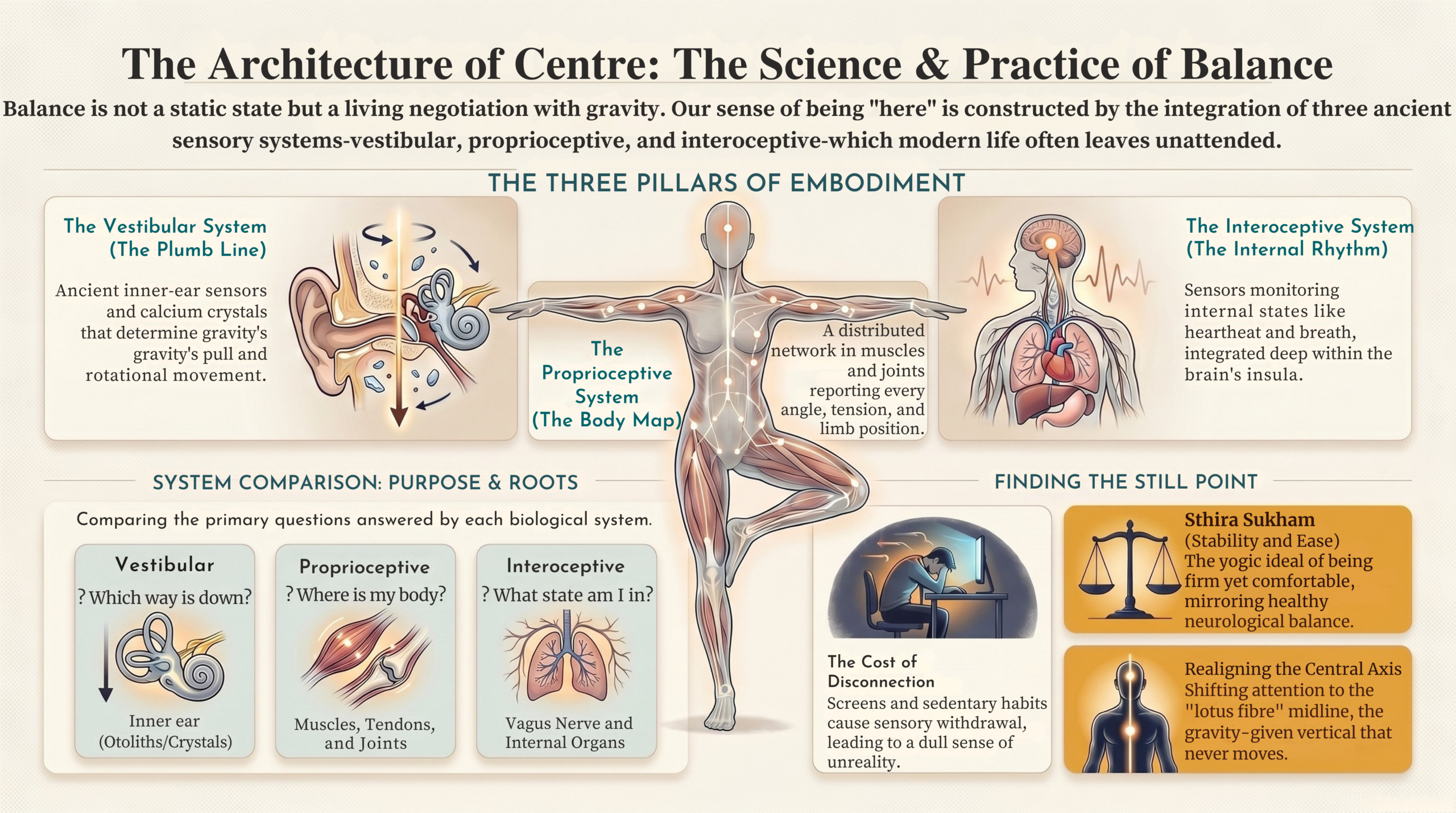
Your body answers this ancient question through three distinct but deeply integrated systems. The vestibular system, housed in the densest bone in your skull, asks: which way is down? The proprioceptive system, a distributed network through every muscle, tendon, and joint in your body, asks: where is my body? The interoceptive system, monitoring heartbeat, breath, and the condition of your internal organs via the vagal nerve, asks: what state am I in?
None of these systems works in isolation. At the very first stage of cortical processing, vestibular signals integrate immediately with proprioceptive and somatosensory information. The insula, the primary cortical site of body awareness, receives heavy vestibular projections. The system that tells you your heart is racing is anatomically continuous with the system that tells you which way is down. Their integration creates something more than the sum of its parts. It creates the felt sense of being here.
A Biology Built on Stone
The vestibular system answers the oldest question in biology, in part, with crystals.
Within the inner ear, five sensory organs occupy a bony labyrinth: three semicircular canals and two otolith organs, the utricle and the saccule. The semicircular canals, arranged at roughly right angles to each other like the three hoops of a gyroscope, detect rotational movement. When you nod, tilt, or turn your head, the fluid within these canals — the endolymph — lags behind the movement and deflects hair cells lining the canals, which signal to the brainstem: you are turning, you are tilting.
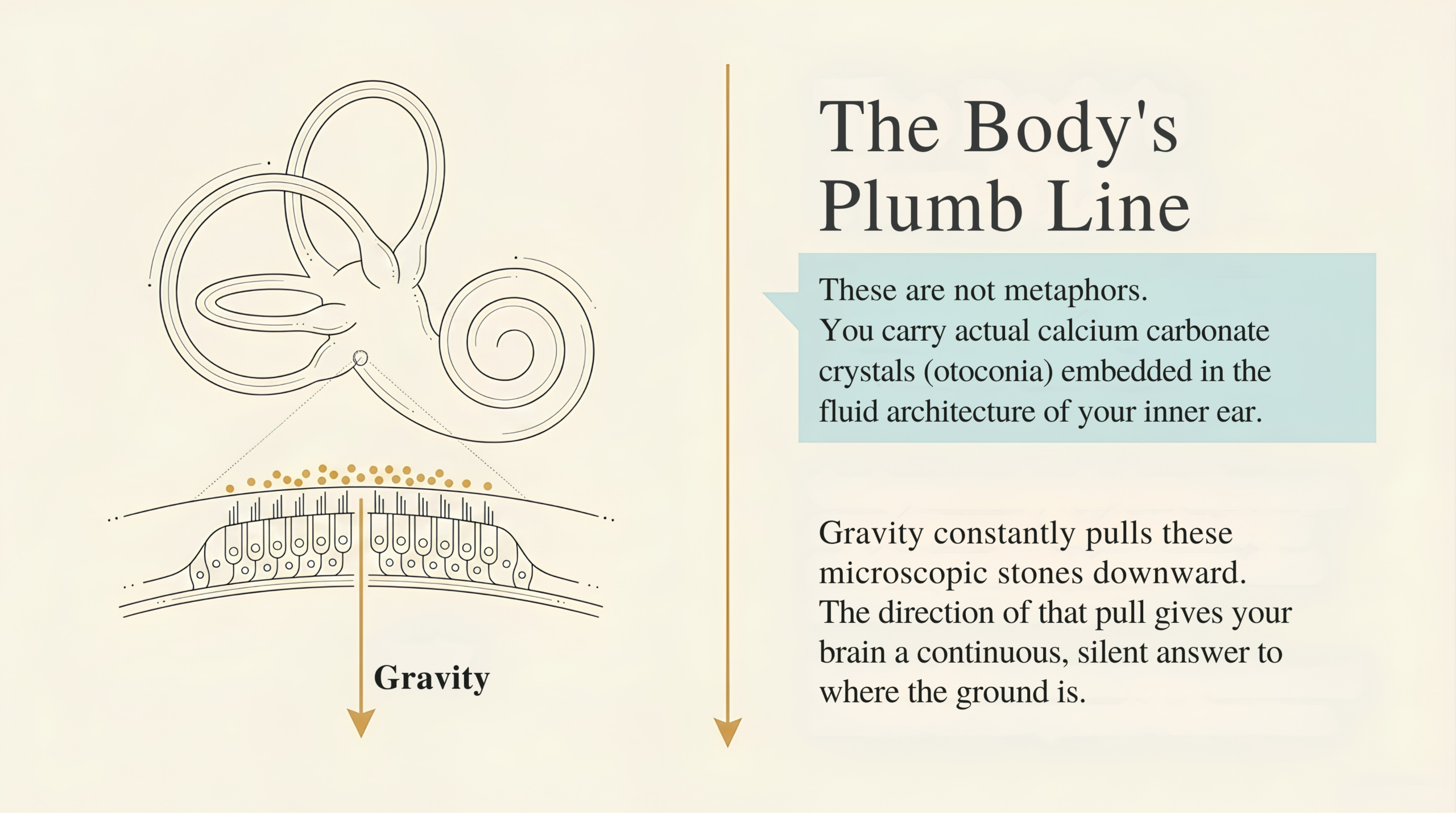
The otolith organs answer a different question. Within each organ, tiny calcium carbonate crystals — otoconia — rest on a membrane studded with hair cells. Gravity pulls these crystals downward constantly. The direction of that pull tells the brain, at every moment, which way is down.
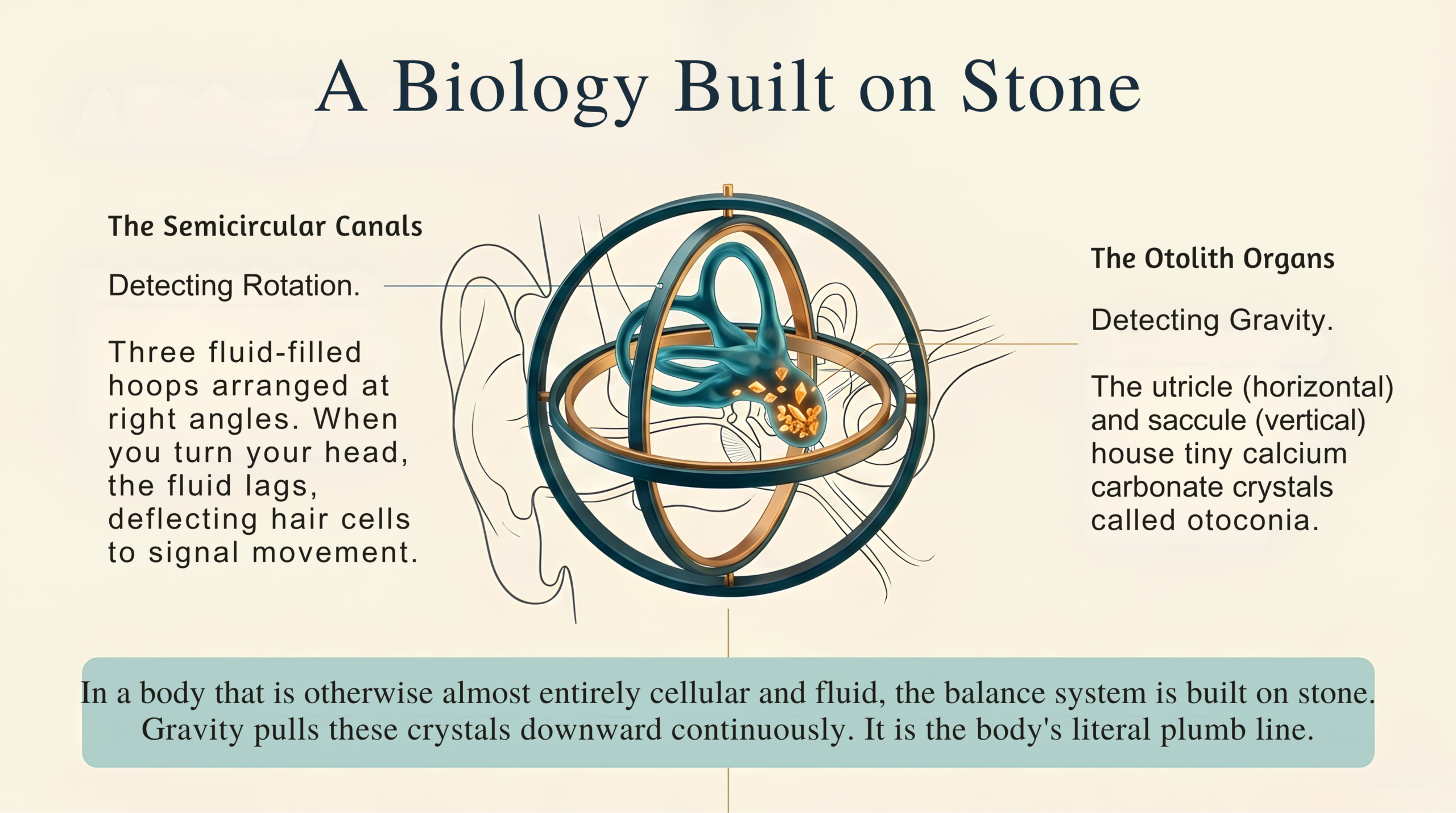
These are not metaphors. In a body that is otherwise almost entirely cellular and fluid, the balance system is built on stone. You carry actual mineral crystals, measuring the pull of the earth against your body, in the fluid architecture of your inner ear. They have existed in some form for half a billion years. They are the body’s plumb line: a continuous, silent answer to the oldest question any nervous system has ever asked.
The Neurological Speed of Presence
Consider what happens to your eyes when you turn your head.
Focus on a point on the wall in front of you and rotate your head quickly from side to side. The point stays stable. Your visual world does not blur or spin. This seems unremarkable until you understand that your eyes are moving in their sockets as you turn, at a rate precisely calculated to compensate for the head movement and keep your visual world anchored. The vestibulo-ocular reflex achieves this with a delay of three to ten milliseconds. For context, the blink reflex takes around a hundred milliseconds. The experience of consciously perceiving anything takes at least two hundred.
Your body has located you in space before you can know it has done so.
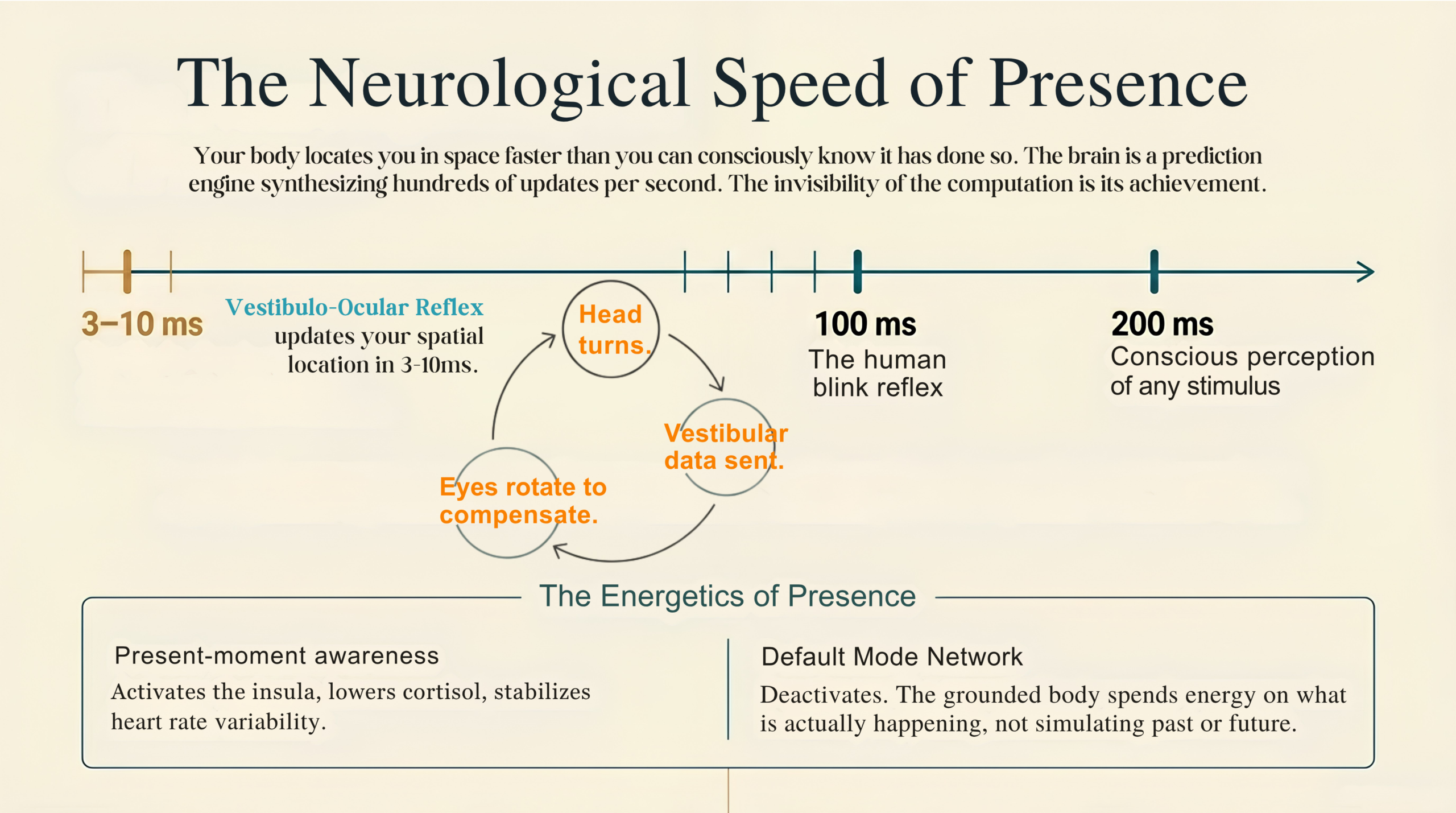
But this is not only a reflex for clear vision. It is the continuous maintenance of a first-person perspective, the exact spatial position from which you experience the world. The brain is, in the language of contemporary neuroscience, a prediction engine: continuously updating its model of where you are based on incoming sensory signals, synthesising hundreds of updates per second. What you experience is not an estimate. You experience it as a simple fact: you are here, in this body, in this moment. The invisibility of the computation is its achievement.
There is something important in the energetics of this. When the vestibular, proprioceptive, and interoceptive systems are working in concert and you are genuinely present to your body, the brain operates in a physiologically distinct mode. Present-moment sensory awareness activates the insula, reduces activity in the default mode network, and is associated with lower cortisol and more stable heart rate variability. Embodied presence is physiologically efficient in a way that rehearsing the past and simulating the future are not. The grounded body is spending its energy on what is actually happening.
To find your centre, neurologically, is simply to turn toward the signals that are always already reporting and allow them to do what they were built to do.
When the Infrastructure Breaks
The clearest window onto any system is its failure. The failure that matters most is not always the kind that arrives with a diagnosis.
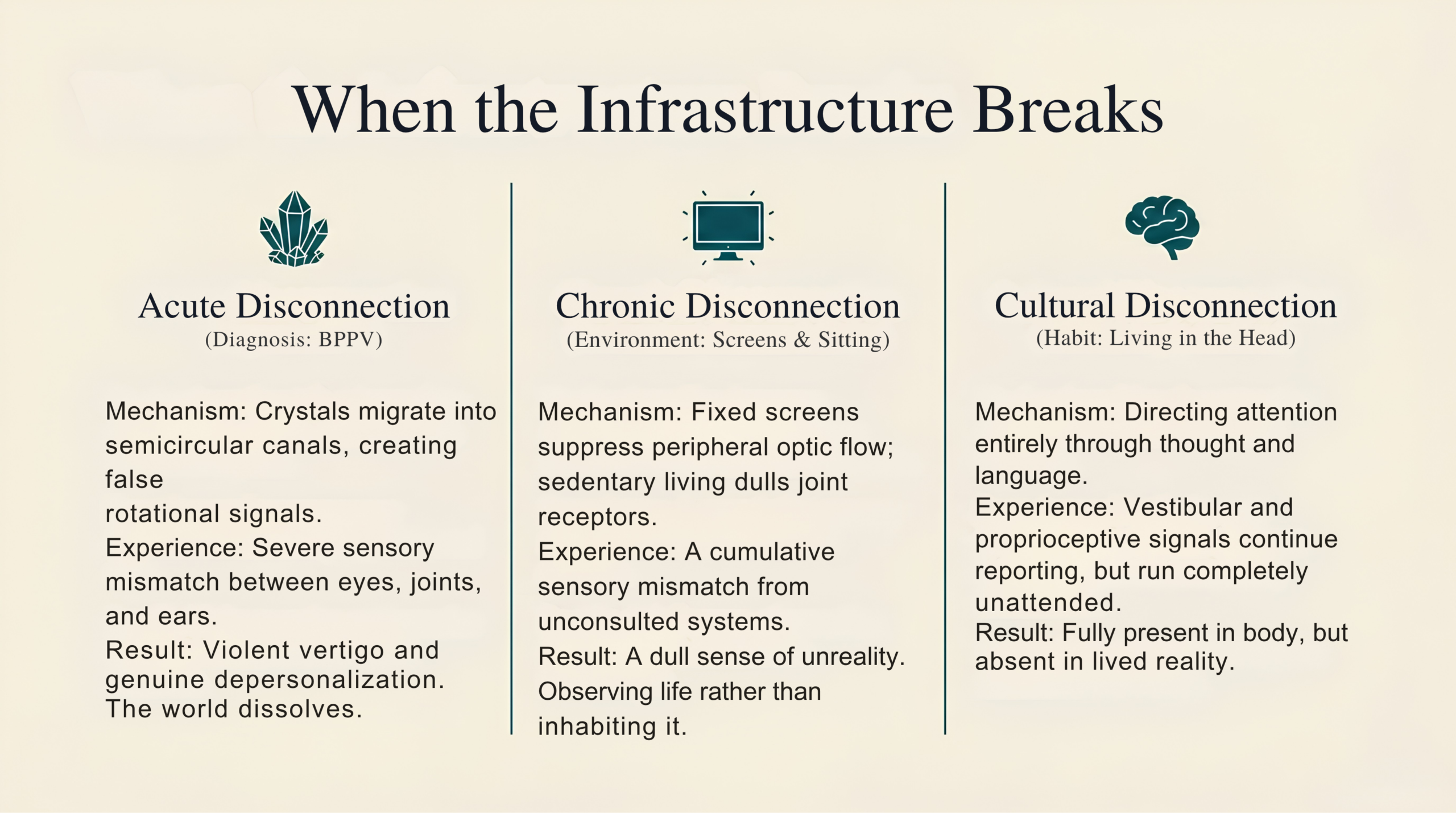
In benign paroxysmal positional vertigo — BPPV, the most common vestibular disorder in clinical practice — the otoconia that normally rest in the utricle become dislodged and migrate into one of the semicircular canals. The canals are not designed to hold crystals. They detect rotation. When displaced crystals shift with head movement, they create a false rotational signal; the canal fires as though the head is spinning at high speed. Vestibular signals now conflict with what the eyes see and what proprioception reports. The brain cannot reconcile the three accounts.
What the patient experiences is not simply dizziness. The world rotates violently. And research by Olaf Blanke and colleagues has shown that severe enough vestibular mismatch can produce genuine depersonalisation, in some cases, the full subjective experience of being located outside the physical body. The self is a construction, continuously maintained by sensory integration. Disturb that integration acutely, and the self moves.
That is the acute failure. The chronic version is quieter and far more common.
Prolonged screen use suppresses the peripheral visual flow that the vestibular system uses to calibrate orientation. When you look at a fixed screen for hours, the optic flow that runs in peripheral vision during ordinary movement disappears. The vestibular system continues to report your position, but one of its key validation signals has gone quiet. The result is a mild, cumulative mismatch: not enough to produce vertigo, but enough to contribute to the dull sense of unreality, the quality of observing rather than inhabiting your life, that many people in contemporary environments report without quite knowing what to name it.
Sedentary living compounds this. The proprioceptive system requires varied movement to maintain its sensitivity. The receptors in joints and muscles depend on regular use, the way a musician’s ear depends on regular listening. A body that sits for eight hours and notices, on standing, that the ground feels uncertain underfoot is experiencing sensory withdrawal from a system that has not been consulted all day.
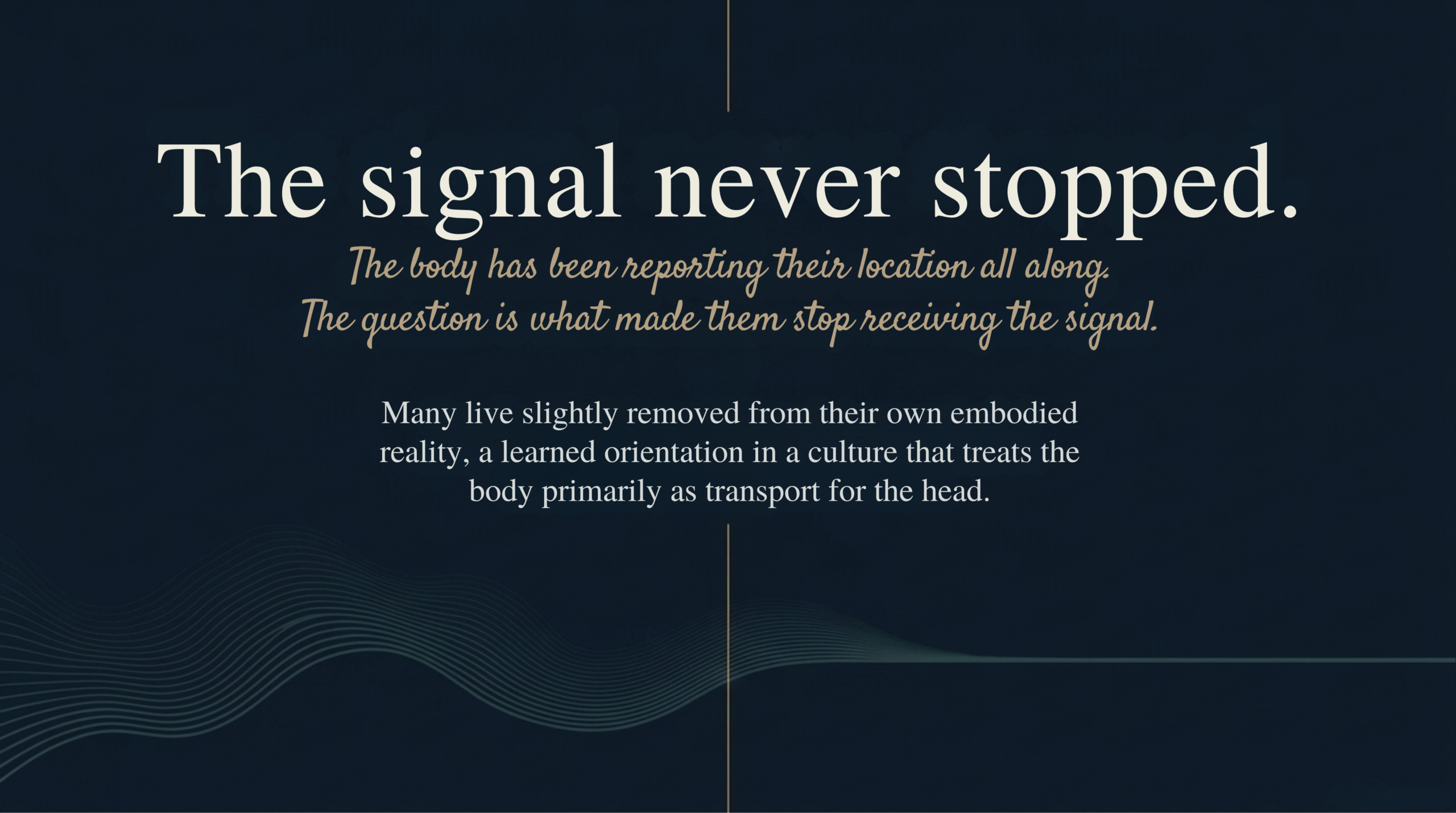
And then there is the subtlest pattern of all, the one that requires no mechanism and no diagnosis. It is the learned habit of directing attention entirely through thought, language, and screen, leaving the vestibular, proprioceptive, and interoceptive signals to run unattended. This is not a disease. It is closer to a cultural practice, reinforced by environments that reward cognitive output and treat the body primarily as transport for the head.
The Signal Never Stopped
Every tradition that has thought carefully about how to live has arrived, without exception, at the same instruction: find your centre, and act from there. The instructions vary. The diagnosis does not.
The Taoist concept of wu wei — effortless action — is, anatomically, what the vestibular system does in every waking moment. Balance is not achieved by forcing. It is found by responding continuously to what is actually there. The cerebellum does not impose stability; it makes constant small adjustments without deliberation, without planning, without a single moment of effort. Wu wei made flesh.
Patañjali’s instruction in the Yoga Sutras — sthira sukham āsanam, the posture should be steady and comfortable, describes precisely the condition of healthy vestibular and proprioceptive function. Not rigidity, which loads the system with unnecessary tension. Not collapse, which offers no structural integrity. But the dynamic stability of a system that holds its centre by continuously adjusting: firm enough to remain, easy enough to breathe.
The neuroscience adds the final word. Blanke’s research at the EPFL has shown that when vestibular integration is sufficiently disrupted, the felt location of the self shifts predictably, reproducibly, outside the body. The self is not fixed. It has an address. And that address is maintained, moment by moment, by three sensory systems working in concert. Can I find my centre? It is not a metaphorical question. It is an anatomical one.
When you turn toward the vestibular, proprioceptive, and interoceptive signals that are always reporting — when you receive the broadcast that has never ceased — the centre does not need to be found. It simply becomes available. It was never absent. It was simply not being consulted.
The Practice: The Grounded Return
The eighth-century Kashmiri text Vijñāna Bhairava Tantra speaks of the central channel — madhya-nāḍī — running from the pelvic floor to the crown of the head, and calls it madhya-saṃsthā: situated in the core of your being. Not to be created. Not to be sought. Already dwelling there, like a lotus fibre, nearly translucent, continuous, easy to overlook precisely because it never stops.
Thirteen hundred years before neuroimaging, this verse was describing what the vestibular axis does in every moment: a gravity-given vertical that does not move, from which all orientation flows. The dancer is most free when they are most grounded. And the practice this tradition offers is not about building the centre. It is about resting attention in what is already there.
You are not building this. You are recognising what has always been here.
Free Download
The Grounded Return — Practice Card
A six-step body practice for finding your centre. Stand. Arrive. Locate the axis. Five minutes, no equipment, anywhere.
Download the Practice Card →Free. No sign-up required.
This post is a summarised web version of the corresponding chapter of Anatomy of Being, a book about the body as a system of meaning.
The still point was always here.
And from it, the dance.
References
Pfeiffer C, Serino A, Blanke O. The vestibular system: a spatial reference for bodily self-consciousness. Front Integr Neurosci. 2014. · Blanke O. Multisensory brain mechanisms of bodily self-consciousness. Nat Rev Neurosci. 2012. · Lopez C. A neuroscientific account of how vestibular disorders impair bodily self-consciousness. Front Integr Neurosci. 2013. · Gallagher S. How the Body Shapes the Mind. Oxford University Press, 2005. · Zahavi D. Subjectivity and Selfhood. MIT Press, 2005. · Wallis CD. Tantra Illuminated. Mattamayura Press, 2013. · Wallis CD. Vijñāna-bhairava-tantra verse-by-verse commentary, verses 34–35. hareesh.org. 2024. · Eliot TS. Four Quartets. Faber & Faber, 1943. · Patañjali. Yoga Sūtras, II.46.