Almost everyone has had the experience of hearing their own recorded voice and not recognising it. It sounds wrong, thinner than expected, more nasal, slightly foreign. You know, intellectually, that the recording is accurate. What you are hearing is precisely what everyone else hears when you speak. And yet it sounds like someone else.
That discomfort is not vanity. It is one of the most revealing facts in all of voice science, and it opens directly onto the question that has occupied me for twenty years of ENT practice: What is my voice?
Of all the things the body produces, only one travels into the world as a signature. Breath sustains you and disappears. Movement leaves no trace. The voice carries forward: it enters the room before you do, and persists in the memory of those who have heard it long after every particular word has faded. It is the one thing that cannot be lent, copied, or assigned to anyone else. And yet most people have never properly heard it, not as it actually sounds, not as others receive it. They know it from the inside, through its making.
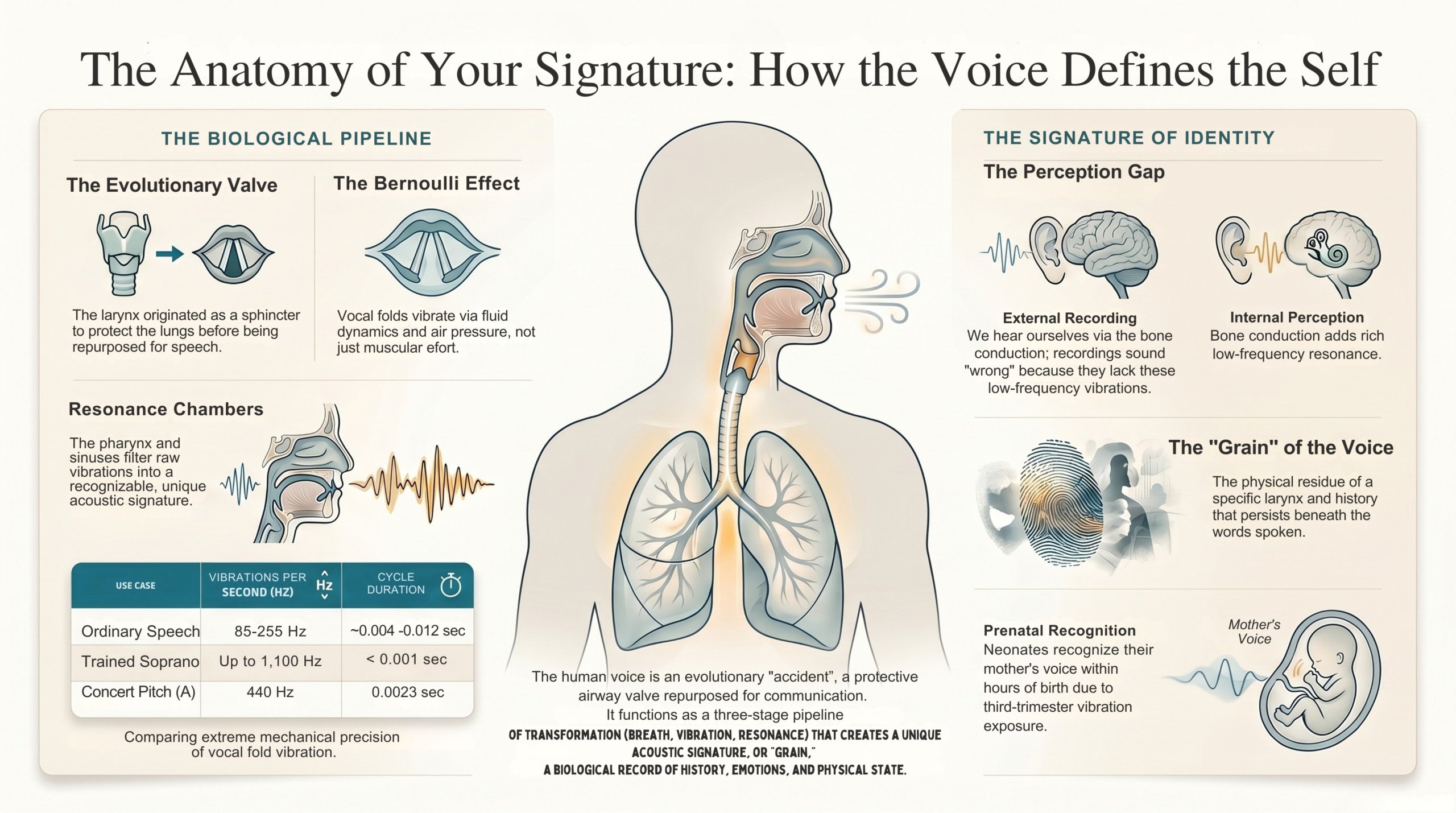
The Larynx Was Not Built for Speech
Reach up and touch your throat just below the Adam’s apple. That notch beneath your fingertip is the upper border of the cricoid cartilage, the base of your larynx. Now swallow. Feel it rise and fall.
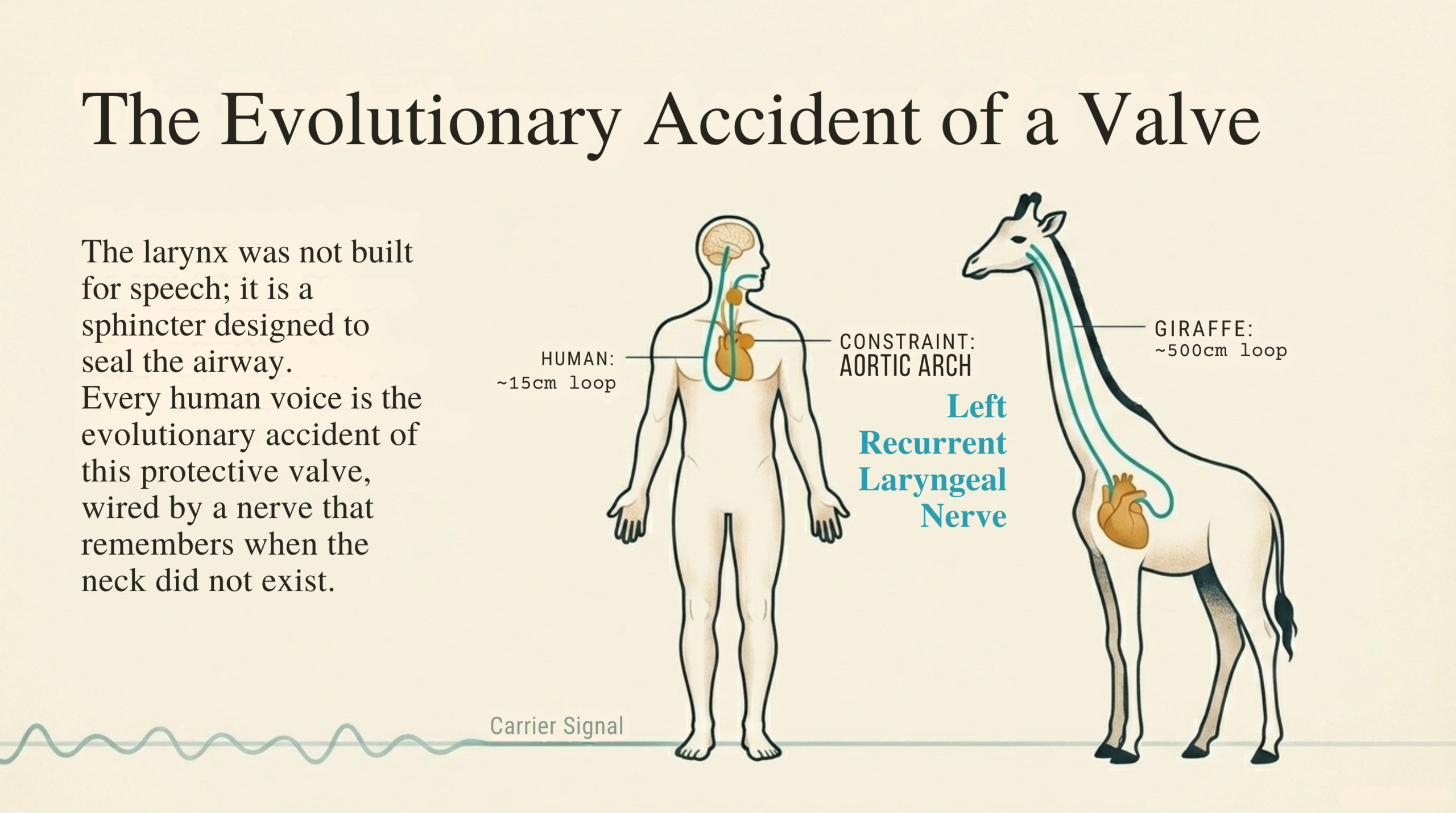
That movement is not voice. It is the voice’s original purpose: protection. The larynx evolved as a valve, a sphincter designed to seal the airway against anything that should not reach the lungs. Your vocal folds were not built for speech. They were repurposed for it.
Every human voice in history is the evolutionary accident of a protective structure finding a second use.
The nerve that controls your vocal cords makes this history visible. The recurrent laryngeal nerve branches from the vagus nerve in the chest, loops beneath the aortic arch, and travels back up the entire length of the neck to reach the larynx at the top of it. In an adult human, this means the nerve travels roughly fifteen centimetres past its destination before returning. In a giraffe, the same nerve runs nearly five metres, looping down from the brain, under the heart, and back up again, because an evolutionary constraint trapped it below a blood vessel it could never cross. As necks lengthened over millions of years, the nerve kept getting longer rather than finding a new path.
Your larynx carries its entire evolutionary history in its wiring: a sphincter that became a voice, served by a nerve that still remembers when the neck was not there.
Why You Have Never Heard Your Own Voice
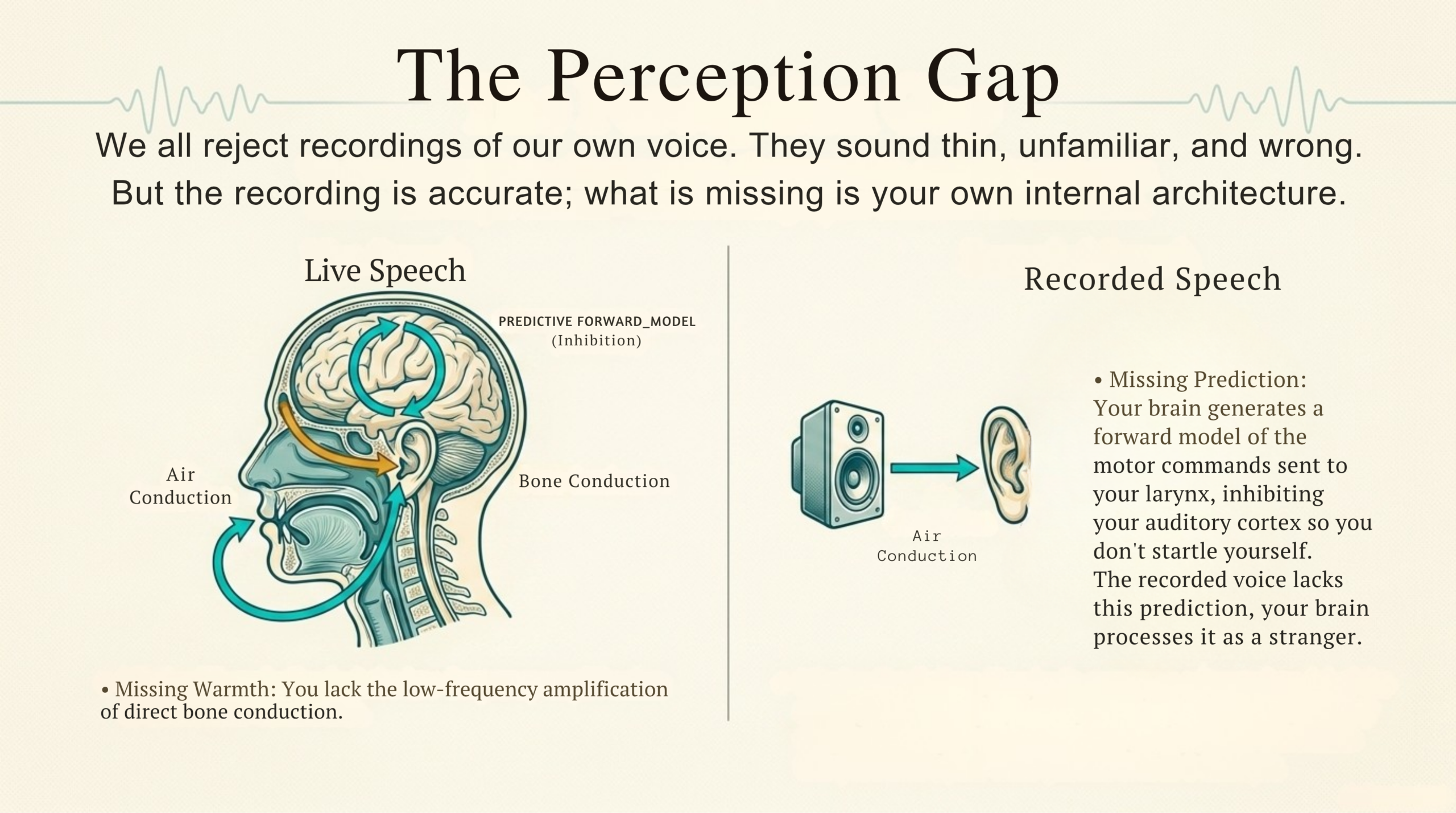
When you speak live, you hear your voice through two pathways simultaneously. The first is air conduction, meaning the sound waves are transmitted through the air into the ear, processed in the usual way. The second is bone conduction: the vibration of your larynx and skull travels directly through the bones of your cranium to the cochlea, bypassing the ear canal entirely. Bone conduction amplifies the lower frequencies. It is the reason your voice sounds richer and fuller to you than to anyone else. A recording captures only the air-conducted signal. When you hear it played back, the warmth from bone conduction is absent, and the voice sounds thin and diminished.
But there is a second reason, less well known and more philosophically significant.
When you speak, your brain generates a prediction of what it is about to hear — a forward model, computed from the motor commands being sent to the larynx. This prediction runs ahead of the auditory signal and partially suppresses your neural response to your own voice. That is why your voice does not startle you the way unexpected sounds can. When you hear a recording, the motor prediction is absent. Your auditory system receives the voice signal without any accompanying prediction and processes it as it would any other voice: as something external, unfamiliar, slightly other.
The key insight
The voice you experience as yours is, in part, a prediction of what you expect to hear when you speak, shaped by decades of simultaneous bone-conducted and air-conducted experience. The voice others hear you have never heard. You know your voice from the inside, through its making, through the vibration in your chest and skull that no one else can feel. In this sense, your voice is irreducibly yours: not the acoustic signal, but the embodied experience of producing it.
The Grain, the History, and the Body That Insists
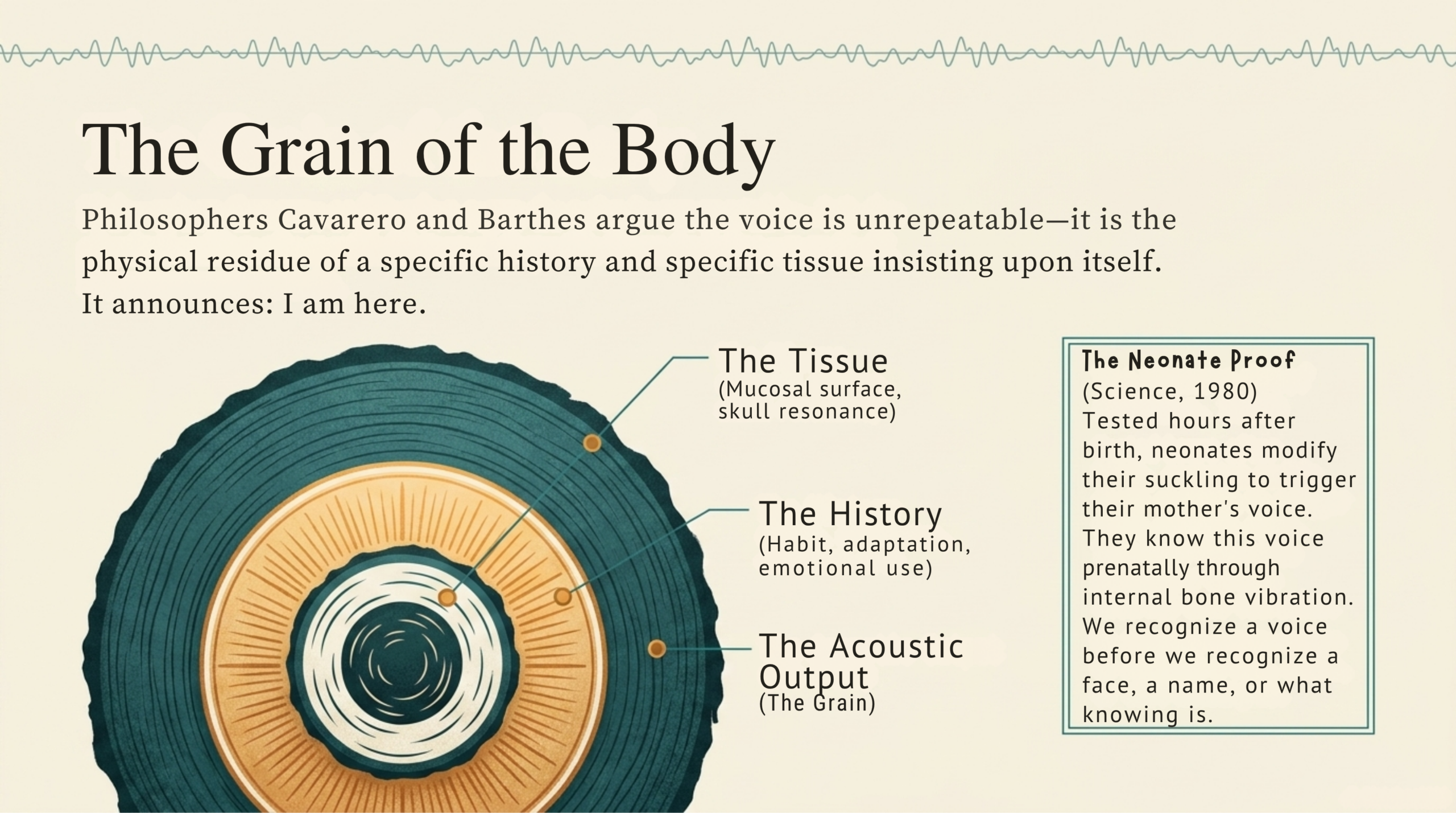
In her work For More Than One Voice, the philosopher Adriana Cavarero makes an argument the anatomy of the previous section confirms. Language is essentially anonymous: the word tree carries the same meaning regardless of who speaks it, and words can be written down, repeated, transmitted across centuries without losing what they contain. The voice cannot. The voice is always and irreducibly the voice of a particular body, a particular history, a particular person.
When someone speaks your name in your mother’s voice, it is not the name that arrests you. It is the voice. The name could be spoken by anyone. The voice is unrepeatable.
Roland Barthes, writing in 1972, gave this unrepeatability a name. He called it the grain of the voice — the physical residue of a specific larynx, a specific pharynx, a specific history of use, that persists in sound beneath and beyond whatever the voice is communicating. Barthes distinguished between what can be taught, the technique, the style, the expressive convention, and what cannot: the body insisting on itself through the sound. The roughness or smoothness of this particular mucosal surface. The resonance of this chest cavity and no other. The way this specific larynx has adapted across decades to every emotion placed upon it.
The grain is what cannot be trained away. It is the tissue speaking.
The voice is individual because the body is individual. It cannot be otherwise.
The Evidence From Before Birth
The deepest confirmation of this comes from a study that has always stopped me when I return to it.
In 1980, Anthony DeCasper and William Fifer published research in Science showing that neonates, tested within hours of birth, consistently modified their sucking patterns to trigger their mother’s voice over a stranger’s. The preference was prenatal in origin. The maternal voice reaches the fetus not only through amniotic fluid and the uterine wall but through the internal vibrations of the mother’s own larynx and chest, transmitted directly through bone. The fetus hears its mother’s voice as vibration felt through the body as much as sound heard through the ear.
Voice recognition precedes all other forms of recognition. We know a voice before we know a face, before we know a name, before we know what knowing is.
What Twenty Years in a Consulting Room Teaches You
I have learned, over twenty years of ENT practice, to attend to the voice before attending to the complaint.
The voice that enters already apologising for itself, slightly constricted, barely projected, as if occupying the room were an imposition. The tight, flat voice of someone whose anxiety has moved so thoroughly into the throat that the pharyngeal muscles are chronically contracted. And most distinctively: the soft voice that is not soft from temperament but from learning. The patient who spent years in a household or a relationship where speaking at full volume attracted consequences they preferred not to repeat. The voice that has learned to take up less space than the body it belongs to.
These are not presentations. They are biographies, compressed into sound.
The grain, in Barthes’s sense, tells you what the words are careful not to say.
What Is My Voice?
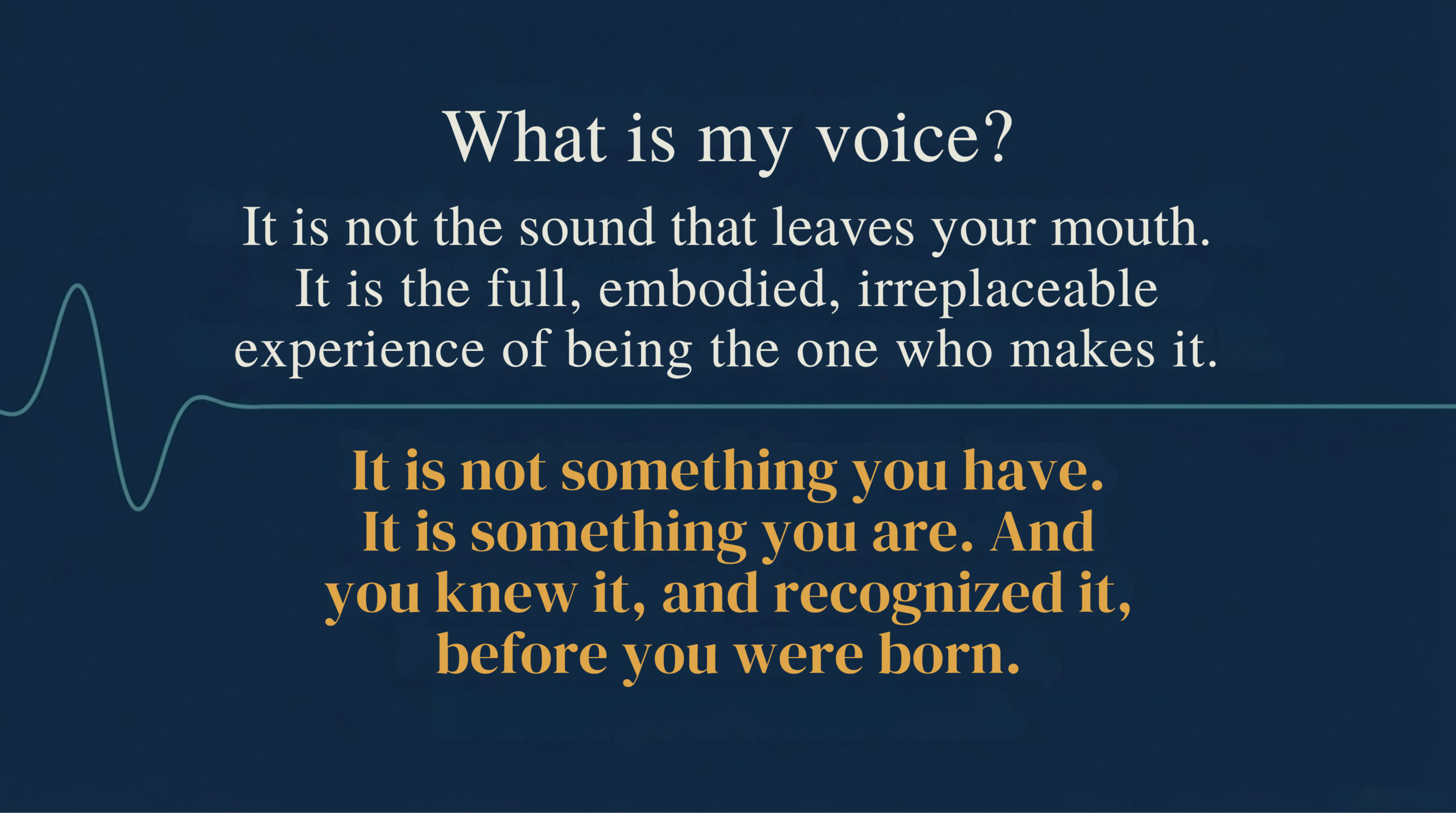
It is not the sound that leaves your mouth. It is not the signal a recording captures, the frequency a spectrogram displays, or the acoustic output a device measures.
It is the full, embodied, irreplaceable experience of being the one who makes it, the motor prediction, the bone vibration, the grain, and the long history of use that has shaped the tissue and the habit and the range. It is not something you have. It is something you are.
And you knew it, and recognised it, before you were born.
The Voiced Return
A printable 5-minute practice card — the uccāra-based vocalization practice from this chapter. To use before a difficult conversation, when the voice feels disconnected from the person it belongs to, or whenever you want to follow your voice back to its source.
This piece is a summarised web version of the corresponding chapter of Anatomy of Being, a book about the body as a system of meaning. The full chapter explores the four levels of sound in Nāda Yoga, the Sufi tradition of dhikr, and the ninth-century Kashmiri practice of uccāra, following the voice all the way to the awareness that receives it when the sound is gone. Order the book on Amazon.
References
Selected sources
- Titze IR. Principles of Voice Production. National Centre for Voice and Speech, 2000.
- Titze IR, Jiang JJ, Hsiao TY. Measurement of mucosal wave propagation and vertical phase difference in vocal fold vibration. Ann Otol Rhinol Laryngol. 1993;102(1):58–63.
- Hosaka T, Kimura M, Yotsumoto Y. Neural representations of own-voice in the human auditory cortex. Sci Rep. 2021.
- DeCasper AJ, Fifer WP. Of human bonding: newborns prefer their mothers’ voices. Science. 1980;208(4448):1174–1176.
- Cavarero A. For More Than One Voice: Toward a Philosophy of Vocal Expression. Stanford University Press, 2005.
- Barthes R. The grain of the voice. In: The Responsibility of Forms. Trans. Howard R. University of California Press, 1985.
- Wallis CD. Vijñāna-bhairava-tantra verse 39: uccāra. hareesh.org, 2024.
- Lundberg JO, et al. Nitric oxide and the paranasal sinuses. Anat Rec. 2008.
A clinical note. This piece is reflective and educational. If you are experiencing hoarseness lasting more than three weeks, unexplained voice change, pain on swallowing, or a lump in the neck, please see an ENT specialist or your GP. Persistent hoarseness in an adult is always worth investigating.